
Choosing the right nib size for your Pilot Kakuno is the single most important decision you will make before purchasing this popular entry-level fountain pen. Because Japanese nib sizes are ground finer than their Western counterparts, a Pilot Extra Fine (EF), Fine (F), or Medium (M) will write a thinner line than you might expect from European brands. To get the best writing experience, you must match the nib size to your handwriting scale, the quality of the paper you use daily, and your preferred ink flow.
If you have tiny, compact handwriting or frequently write on cheap, absorbent paper, the Extra Fine or Fine nib will prevent your letters from closing up. If you prefer a smooth, gliding sensation and want your ink colors to show their full character, the Medium nib is the ideal choice. Understanding these nuances ensures your pen becomes a reliable daily companion rather than a source of frustration.
Quick Guide: Which Pilot Kakuno Nib Fits Your Needs?
To help you make an immediate decision, the table below summarizes how each Pilot Kakuno nib size performs across key writing criteria.
Products mentioned in this guide
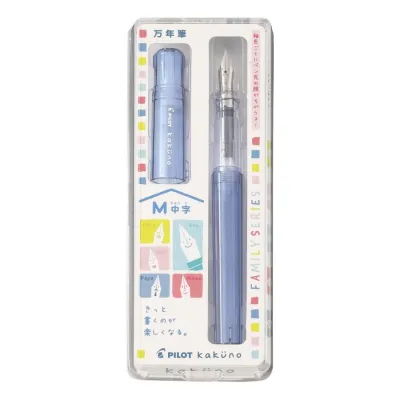
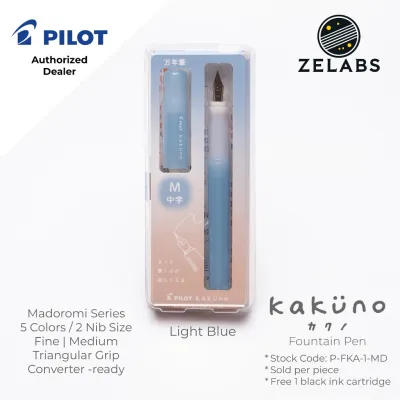
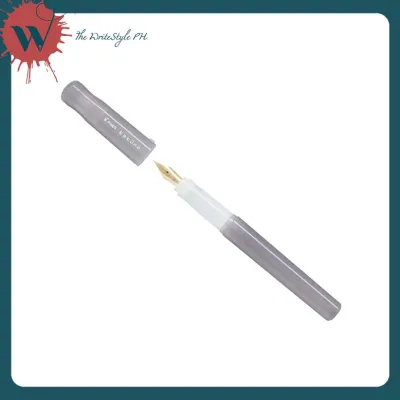
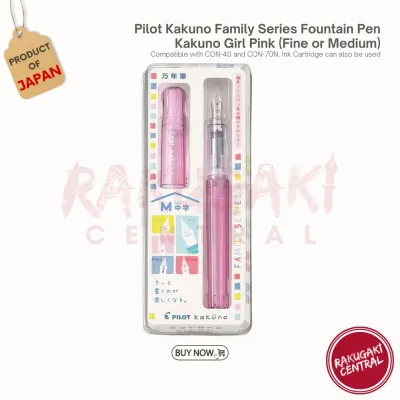
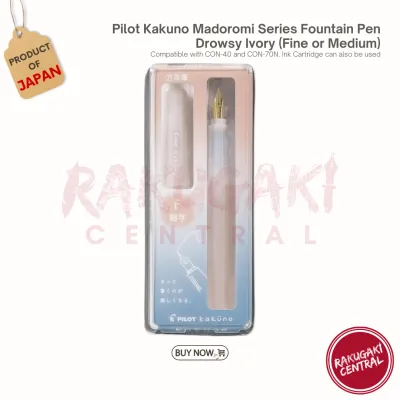
Prices are valid at publication and may change. Please refer to the product page for the latest price.
| Nib Size | Relative Line Width | Ink Flow | Paper Tolerance | Best Suited For |
|---|---|---|---|---|
| Extra Fine (EF) | Ultra-thin (like a 0.3mm gel pen) | Very dry / Controlled | High (resists feathering on cheap paper) | Tiny handwriting, margin notes, math formulas, grid journals |
| Fine (F) | Thin (like a 0.4mm to 0.5mm gel pen) | Moderate / Balanced | Medium (works well on most standard paper) | Daily note-taking, schoolwork, general journaling, planners |
| Medium (M) | Medium-bold (like a 0.7mm gel pen) | Wet / Generous | Low (requires fountain-pen-friendly paper) | Large handwriting, ink shading/sheening, signatures, sketching |
If you are completely unsure which size to choose, the Fine (F) nib is the safest and most versatile default option. It strikes an excellent balance between a smooth writing feel and a controlled ink flow, making it highly forgiving on standard school notebooks and office copy paper.
Before finalizing your purchase, you can easily identify the nib size of a Pilot Kakuno by looking closely at the metal nib itself. The size letter (EF, F, or M) is stamped directly onto the face of the steel nib, right next to the iconic engraved smiley face. On the outer packaging, the nib size is typically printed on a white sticker on the side or back of the box, or clearly displayed on the front card of the plastic blister pack.
Understanding the Differences Between EF, F, and M Nibs
The differences between the three Pilot Kakuno nib sizes go far beyond the thickness of the line they leave on the page. Each size alters the physical mechanics of how ink travels from the pen’s reservoir to the paper, which directly impacts how the pen feels in your hand.

Line Width and Ink Flow Dynamics
Because Japanese writing systems require high precision for intricate characters, Pilot grinds its nibs to be significantly finer than Western brands. An EF nib has an incredibly small contact point with the paper. This restricted contact area naturally limits the amount of ink that can flow through the nib slit via capillary action.
As a result, the EF nib writes with a dry, highly controlled line that dries almost instantly. The F nib increases the contact area slightly, allowing a more generous but still disciplined flow of ink. The M nib features a much larger, rounded tipping material, which acts like a wider highway for the ink. This results in a wetter writing experience where the ink pools slightly on the page, bringing out the vibrant colors, shading, and sheen of your chosen ink.
Feedback and the Scratchiness Trade-Off
A common misconception is that finer nibs are defective because they feel scratchy. In reality, this sensation is known as feedback. Because the tipping material on an EF nib is so microscopic, it acts like a fine needle, transmitting the texture of the paper fibers directly up the pen barrel to your fingers.
If you write with a heavy hand, an EF nib will dig into the paper, causing it to catch and feel rough. The F nib offers a much smoother experience while retaining a pleasant pencil-like feedback that helps you control your strokes. The M nib, with its generous ball of tipping material, glides effortlessly across the page with minimal resistance. If you prioritize a buttery-smooth feel above all else, the M nib is the clear winner, whereas the EF requires a light touch and a patient hand.
Kakuno's Nib Geometry and Feed Design
The Pilot Kakuno utilizes a stiff, stainless steel nib that does not flex under pressure. This rigidity is intentional, designed to help beginners maintain a consistent writing angle.
The plastic feed underneath the nib is engineered to regulate ink flow consistently across all three sizes, but the physical gap between the tines of the nib is set at the factory to match the specific size. The EF nib has tightly set tines to restrict flow, while the M nib has a slightly wider gap to encourage a wetter line. This means you cannot easily make an EF write like an M simply by pressing harder; doing so will only misalign the tines and ruin the pen.
Matching the Nib to Your Handwriting and Paper Type
To avoid post-purchase regret, you must evaluate your personal writing habits and the specific materials you use daily. A nib that performs beautifully in a premium journal might be unusable on standard office paper.
Assessing Your Handwriting Size
Take a look at your natural handwriting. If you write in small, cramped print, or if you frequently write Chinese, Japanese, or Korean characters, an EF or F nib is essential. A Medium nib will deposit too much ink, causing the loops of letters like “e,” “a,” and “g” to fill in and become illegible blobs.
Conversely, if you have large, sweeping cursive handwriting or enjoy expressive print, an EF nib will look thin, faint, and visually unbalanced on the page. The M nib allows your letterforms to look full, bold, and authoritative.
Evaluating Paper Quality in Tropical Climates
Paper quality is the ultimate gatekeeper of the fountain pen experience. In warm, highly humid tropical climates like the Philippines, paper fibers naturally absorb moisture from the air, making them highly hygroscopic. This ambient humidity makes standard school notebooks, cheap copy paper, and exam sheets incredibly absorbent.
When a wet-writing M nib meets humid, low-quality paper, the ink immediately spreads out (feathering) and leaks through to the back of the page (bleed-through). If you must use standard, budget-friendly paper for school or office work, the EF or F nib is highly recommended. Their dry, controlled ink delivery prevents the ink from saturating the damp paper fibers, allowing you to write on both sides of a page without issue. If you have invested in premium, fountain-pen-friendly paper that resists absorption, the M nib will perform beautifully, allowing you to appreciate the ink’s true depth.
Aligning with Your Daily Use Cases
Your primary activities should dictate your choice:
- Daily Note-Taking and Exams: The F nib is the undisputed champion here. It is fast-drying, legible on almost any paper, and comfortable for long writing sessions.
- Journaling and Creative Writing: If you use high-quality journals, the M nib elevates the experience by making writing feel luxurious and showcasing beautiful ink characteristics.
- Planners and Pocket Notebooks: Planners often have tiny grid layouts or thin paper. The EF nib is perfect for squeezing detailed notes into small calendar boxes.
- Sketching and Drawing: Artists often keep both an EF for fine detail work and hatching, and an M for bold outlines and ink washes.
Pre-Purchase Checks and Ink Pairing Guidelines
Before you click buy or head to your local stationery store, there are several practical compatibility and setup details you must verify to ensure a seamless experience.
Verifying Nib Markings and Colorways
The Pilot Kakuno is famous for its colorful caps and pastel bodies, but do not assume a specific body color dictates the nib size inside. Retailers often stock different combinations, and regional packaging can vary.
Always double-check the specific nib size listed on the product label rather than relying on the pen’s aesthetic color. Some special editions or clear-body (demonstrator) models may only be available in F or M sizes in certain markets, so read the specifications carefully.
Cartridge and Converter Compatibility
The Kakuno uses Pilot’s proprietary cartridge and converter system. It will not accept standard international cartridges. When you buy the pen, it typically comes with one black Pilot ink cartridge. If you want to use bottled ink, you will need to purchase a compatible converter separately.
The Kakuno is compatible with the Pilot CON-40 converter. Alternatively, many users prefer to reuse the included empty cartridge by refilling it with a blunt-tip syringe, as the cartridge holds significantly more ink than the CON-40 converter. This is especially useful for the thirsty M nib, which empties ink reservoirs quickly.
Pairing the Right Ink with Your Nib
The viscosity and lubrication of your ink can dramatically alter how your Kakuno writes:
- For EF and F Nibs: These dry-writing nibs benefit from wet or highly lubricated inks. A wet ink flows more easily through the narrow channel, reducing feedback and making the fine tip glide more smoothly. Standard Pilot Namiki bottled ink or Pilot Iroshizuku inks are exceptionally well-lubricated and pair perfectly with finer nibs.
- For M Nibs: Because the M nib already flows generously, pairing it with an extremely wet ink on standard paper can result in excessive feathering. If you find your M nib too wet, try pairing it with a dry ink (such as those formulated by Pelikan or Lamy) to tame the flow.
- Climate Considerations: In humid environments, pigment-based or permanent inks may dry slower on the page. If you require water resistance for school or legal documents, ensure you test the drying speed of your ink-and-nib combination before committing to important tasks.
Frequently Asked Questions (FAQ)
Can I swap the nib on my Pilot Kakuno later?
Yes, you can easily swap the nib on your Pilot Kakuno. The Kakuno shares the exact same nib and feed friction-fit architecture as several other entry-level Pilot models, including the Pilot Metropolitan (Cocoon), Pilot Prera, Pilot Penmanship, and Pilot Plumix.
To perform a swap, ensure the pen is completely clean and flushed of ink. Grip the sides of the metal nib and the plastic feed firmly using a piece of rubber grip or a clean paper towel to prevent slipping. Pull them straight out of the section together with a steady, firm motion—do not twist, as this can damage the alignment keys inside the grip section. To insert the new nib, align it flat against the top of the feed, slide them back into the grip section, and press firmly until they click securely into place.
Does the nib size affect how the pen feels on rough paper?
Yes, there is a direct relationship between nib size and paper texture feedback. Finer nibs (especially the EF) have a very small surface area in contact with the paper, which causes them to catch on loose paper fibers and feel scratchy on rough, textured, or low-grade recycled paper.
If you must write on rough paper, you can improve the experience by using an extremely light writing pressure—fountain pens do not require you to press down to write. Additionally, using a highly lubricated, wet ink can help create a thin cushion of fluid between the metal tip and the paper fibers, reducing friction. If rough paper is unavoidable in your daily routine, choosing a Fine (F) or Medium (M) nib will provide a much more comfortable and forgiving writing experience.
Is the Pilot Kakuno nib the same as the Metropolitan or Prera?
Functionally, yes. The Pilot Kakuno, Metropolitan, and Prera all use the exact same steel nib and plastic feed design. This means an F nib on a Kakuno will produce the exact same line width and ink flow as an F nib on a Metropolitan or Prera.
The primary difference lies in the cosmetic engraving on the face of the nib. The Kakuno features a playful smiley face (which varies slightly depending on the model year and body color), while the Metropolitan and Prera feature a more traditional, professional scrollwork pattern. However, the overall writing experience differs due to the pens’ body designs. The Metropolitan has a heavier, round brass body, while the Kakuno is made of lightweight, hexagonal plastic with a molded triangular grip section designed to guide your fingers into a proper writing posture.

Community discussion
Share your experience or ask a question. Comments are reviewed before publication.