
Quick Answer: Which Loose Leaf Format Fits Your Workflow?
When choosing loose leaf paper, the best format is the one that directly matches your primary daily task. There is no single superior layout; instead, each pattern serves a distinct cognitive and practical purpose.
- Ruled paper is ideal for heavy text, continuous handwriting, and linear lecture notes.
- Grid paper excels at technical drawings, mathematical equations, and structured column layouts.
- Blank paper offers complete freedom for sketching, mind mapping, and unconstrained brainstorming.
- Dotted paper provides a subtle, flexible hybrid structure perfect for bullet journaling, custom planners, and mixed-media notes.
To build an efficient study or work system, identify your dominant daily task before buying loose leaf paper in bulk. Selecting a format that aligns with your natural processing style prevents visual clutter and streamlines your workflow.
Comparing the Four Loose Leaf Paper Formats
The printed pattern on a sheet of loose leaf paper does not merely sit in the background; it actively guides your hand and structures your thoughts. The layout you choose dictates your handwriting speed, spatial organization, and visual clarity, transforming a simple stack of paper into a specialized productivity tool. Understanding how each format alters your interaction with the page is the first step in optimizing your note-taking setup.
Products mentioned in this guide
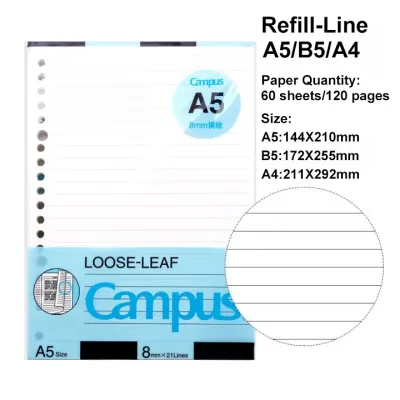
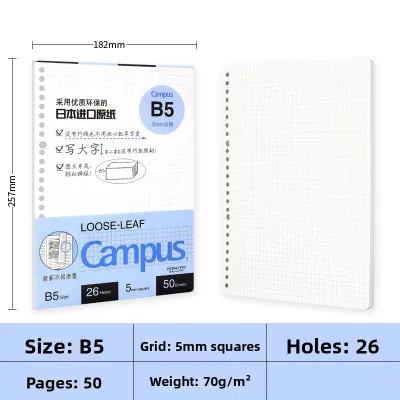
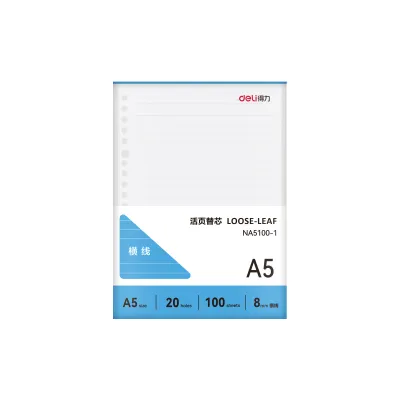
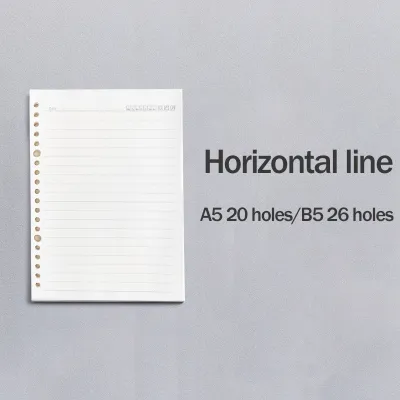
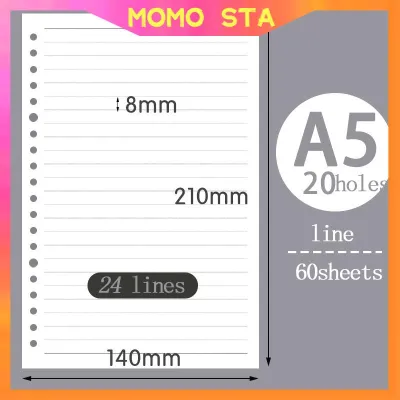
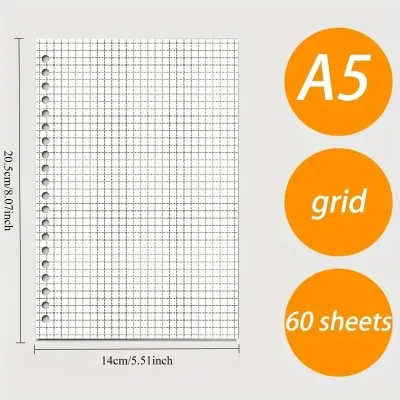
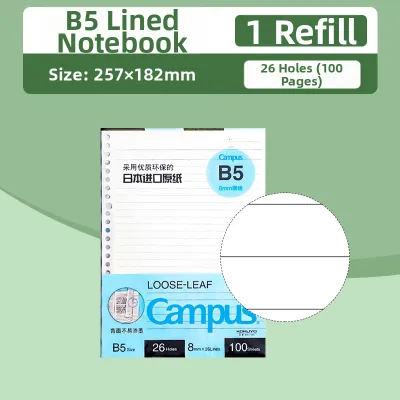
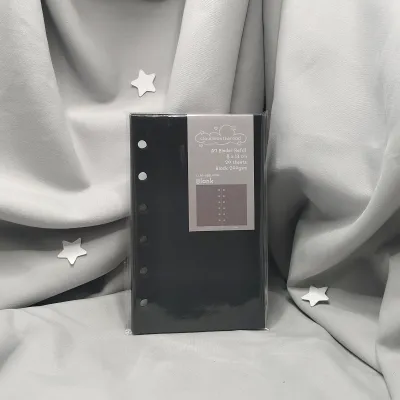
Prices are valid at publication and may change. Please refer to the product page for the latest price.

Ruled (Lined) Paper: The Standard for Structured Text
Ruled paper remains the classic standard for academic and professional environments. Featuring consistent horizontal lines—typically spaced at 6mm (narrow or college ruled) or 8mm (wide ruled)—this format acts as a physical track for your pen. The primary advantage of ruled paper is its ability to keep handwriting perfectly aligned and uniform. By providing a clear baseline, it reduces the cognitive load required to keep your writing straight, allowing you to focus entirely on synthesizing information in real-time.
This structured alignment makes ruled paper the undisputed choice for long-form writing, essay drafting, literature notes, meeting minutes, and language learning. When you need to capture spoken lectures quickly, ruled paper allows you to write rapidly without worrying about vertical drifting. The margins on the left side also provide a designated space for dates, cues, or correction marks, making it highly compatible with structured note-taking methods like the Cornell system.
However, this rigid horizontal structure becomes a significant constraint when your work shifts away from text. Attempting to sketch a quick diagram, map out an organic flowchart, or draw a custom table over horizontal lines often results in a cluttered, confusing layout. Writing vertically or diagonally requires you to actively ignore the printed lines, which can be visually jarring and mentally distracting.
Grid (Graph) Paper: The Tool for Precision and Technical Work
Grid paper, also known as graph paper, features intersecting horizontal and vertical lines that form a continuous matrix of small squares, usually measuring 5mm by 5mm. This layout provides precise, two-dimensional alignment, giving you total control over both horizontal and vertical spacing. Every square acts as a unit of measurement, making it incredibly easy to maintain scale and proportion without needing a ruler.
This format is the premier tool for science, technology, engineering, and mathematics (STEM) students, as well as architects, designers, and programmers. The grid structure simplifies plotting coordinate axes, drawing geometric shapes, aligning decimal points in long columns of numbers, and mapping out chemical structures. It is also highly valued by hobbyists for planning structured crafts like pixel art, cross-stitch patterns, or floor plans.
On the downside, the dense network of intersecting lines can create substantial visual noise. If you are writing pages of continuous, plain text, the dark grid lines can compete with your handwriting, making the page feel busy and difficult to read. Furthermore, certain ink colors—especially light blues or greens—can blend into the printed grid, reducing the legibility of your notes. To mitigate this, many premium stationery brands print their grids in incredibly faint gray or pastel tones, though the visual presence of the lines remains a factor.
Blank Paper: Total Freedom for Visual Thinkers
Blank loose leaf paper offers a completely unprinted, clean surface. Free from lines, grids, or dots, it removes all spatial boundaries and allows your pen to move in any direction. This lack of structure encourages creative freedom, making it the ultimate blank canvas for organic brainstorming and visual exploration.
This format is highly favored by art students, graphic designers, visual thinkers, and anyone who relies on mind mapping, flowcharts, and large-scale sketching. Without background lines to disrupt your drawings, your sketches and diagrams remain clean and professional. Blank paper also allows you to mix text sizes, write at creative angles, and integrate detailed illustrations directly alongside your written concepts without any visual interference.
However, the complete absence of guidance is also the primary challenge of blank paper. Writing straight, uniform lines of text across an unlined sheet requires significant practice, muscle memory, and a steady hand. Without a visual anchor, text blocks tend to drift upward or downward, and maintaining consistent letter sizing becomes difficult. This can make final study notes look disorganized and hard to review later. For those who still want to use blank paper for text, placing a dark lined guide sheet underneath the page can provide temporary alignment, though this adds an extra step to your workflow.
Dotted Paper: The Hybrid for Flexible Organization
Dotted paper features a subtle grid of small, light dots, typically spaced 5mm apart. It serves as a modern hybrid, offering the structural benefits of grid paper with the visual minimalism of blank paper. The dots are prominent enough to guide your pen when drawing straight lines, boxes, and custom layouts, yet faint enough to fade into the background once the page is filled with writing.
This format has achieved massive popularity due to the rise of bullet journaling, habit tracking, and creative planning. It allows users to quickly design custom calendars, weekly spreads, and data tables without the heavy, restrictive lines of a traditional grid. Dotted paper easily accommodates both structured handwriting and freeform sketching, making it an incredibly versatile option for multi-disciplinary work.
While dotted paper offers exceptional flexibility, it does require a bit more mental effort to use than ruled paper. You must visually “connect the dots” to keep your writing straight, which can slightly slow down your handwriting during high-pressure lecture note-taking. For pure, rapid text entry, some users still find the continuous lines of ruled paper more comfortable and less fatiguing over long writing sessions.
Key Decision Factors: Structure, Flexibility, and Compatibility
Choosing the right loose leaf format requires balancing your need for structure against your desire for creative flexibility. To help you weigh these trade-offs, the table below compares the four formats across key practical dimensions:
| Format | Handwriting Guidance | Layout Flexibility | Diagram & Drawing Support | Best Subject or Task |
|---|---|---|---|---|
| Ruled | High | Low | Low | Literature, History, Essay Writing, Meeting Minutes |
| Grid | High | Medium | High | Mathematics, Physics, Engineering, Accounting, Pixel Art |
| Blank | None | High | High | Sketching, Mind Mapping, Graphic Design, Brainstorming |
| Dotted | Medium | High | High | Bullet Journaling, Project Planning, Chemistry, Mixed-Media |
Beyond the printed pattern on the page, physical paper specifications are universal factors that dictate usability. A loose leaf system is only as useful as its binder compatibility. Before purchasing paper in bulk, you must verify your existing binder’s ring capacity, paper size, and punch-hole spacing.
For example, international standards vary widely. The highly popular B5 size (often featuring 26 holes) and A5 size (featuring 20 holes) are common in Asian stationery systems, while standard A4 paper typically uses 30 holes. Traditional Western systems rely on 3-hole or 2-hole punch configurations on Letter-sized paper. Attempting to fit a 26-hole B5 sheet into a standard 3-ring binder is physically impossible without tearing the paper or using an external hole punch. Always double-check that the hole pattern of your loose leaf pack matches the exact ring configuration of your binder to avoid purchasing unusable paper.
The Decision Framework: Choose Your Ideal Format
To finalize your choice, use this straightforward, conditional framework to identify which paper layout matches your daily routine:
- Choose Ruled if your daily work is predominantly text-based, you need to write quickly and continuously during lectures or meetings, and you prefer a traditional, highly organized layout that keeps your handwriting neat and aligned.
- Choose Grid if you study or work in STEM fields, frequently write out mathematical formulas, need to align numbers in precise columns, or regularly draw scaled diagrams and technical schematics.
- Choose Blank if you are a visual thinker, designer, or artist who finds printed lines restrictive, and your notes consist primarily of mind maps, sketches, and organic brainstorming sessions.
- Choose Dotted if you practice bullet journaling, enjoy creating custom layouts, trackers, and tables, and want a clean, modern aesthetic that offers structural guidance without visual clutter.
- Verify first if your existing binder's paper size (A4, B5, A5, or Letter) and ring-hole standard (30, 26, 20, or 3-hole) match the loose leaf paper you intend to buy.
Buying Guide: Paper Weight, Punch Holes, and Pen Compatibility
Once you have selected your ideal page format, the physical quality of the paper will determine how enjoyable it is to write on. The most critical specification to look for is paper weight, measured in GSM (Grams per Square Meter). The weight of the paper directly influences how it handles different types of ink, especially in humid climates.
Standard, budget-friendly loose leaf paper typically ranges from 70 to 80 GSM. This weight is perfectly suitable for everyday writing with ballpoint pens and standard gel pens. However, thin paper is highly susceptible to “ghosting” (where writing is visible on the reverse side of the page) and “bleed-through” (where ink actually penetrates through the paper fibers). If you regularly use wet ink sources like fountain pens, rollerballs, heavy highlighters, or artistic brush pens, you should look for premium loose leaf paper rated at 90 to 100+ GSM.
In tropical environments like the Philippines, high relative humidity can cause thin paper fibers to absorb atmospheric moisture. This moisture absorption softens the paper structure, making even decent 70 GSM paper perform poorly by causing inks to feather (spread out like a spiderweb) and bleed. Opting for high-density, moisture-resistant paper of 80 GSM or higher helps maintain sharp, crisp lines regardless of the weather. Keeping your loose leaf paper stored in a dry drawer or a sealed plastic sleeve when not in use will also preserve its writing quality.
If you are transitioning to a new format like dotted or grid for the first time, avoid buying massive bulk packs. Instead, purchase a small sample pack or a single notebook of that format. This allows you to test how your specific pens interact with the paper texture and line spacing before committing to a larger organizational system.
Frequently Asked Questions (FAQ)
Proper organization and tool compatibility are just as important as the paper format itself. Below are answers to common questions about managing a loose leaf binder system.
Can I mix different paper formats in the same binder?
Yes, mixing different paper formats within a single binder is highly effective and is one of the greatest benefits of a loose leaf system. You can easily place ruled paper at the front of your binder for lecture notes, insert grid paper in the middle for mathematical calculations, and keep dotted or blank paper at the back for creative sketching and project planning.
To ensure this system functions smoothly, make sure that all the different paper formats you purchase share the exact same paper size (such as B5 or A5) and hole-punch standard so they turn easily on your binder rings. Utilizing colored divider tabs with labeled indexes is an excellent way to separate these formats by subject or task, keeping your multi-subject binder neat and navigable.
Is dotted paper harder to find than ruled or grid paper?
Traditionally, ruled and grid paper have been much easier to find because they are standard school supplies stocked by almost every local department store and neighborhood bookstore. Dotted paper was once considered a niche specialty item primarily used by designers and bullet journaling enthusiasts.
However, due to the global popularity of creative planning, dotted loose leaf paper has become widely accessible. While you might still find limited options in basic convenience stores, specialized stationery shops, boutique paper retailers, and major online marketplaces carry a massive variety of dotted loose leaf options. These online platforms offer diverse choices in paper weights, sizes (such as B5 and A5), and hole configurations to fit almost any binder system.

Community discussion
Share your experience or ask a question. Comments are reviewed before publication.