
Selecting the right binder notebook refill depends on matching the paper format to your specific note-taking system, organizational habits, and preferred writing tools. Unlike traditional bound notebooks, a binder system offers the unique flexibility to swap, rearrange, and combine different paper types to suit your changing daily needs. By understanding how ruled, grid, dotted, and blank formats perform under different writing scenarios, you can build a highly customized setup that enhances both your productivity and creative expression.
In tropical climates like the Philippines, high ambient humidity can significantly affect how paper fibers interact with ink. Moist air can soften paper, making it more susceptible to ink feathering, ghosting, and longer drying times. Choosing the correct refill format and verifying its physical specifications ensures that your notes remain clean, legible, and structured, regardless of the weather or the writing instrument you use.
How Each Paper Format Supports Different Note-Taking Styles
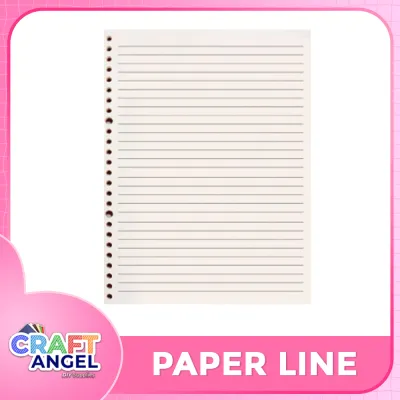
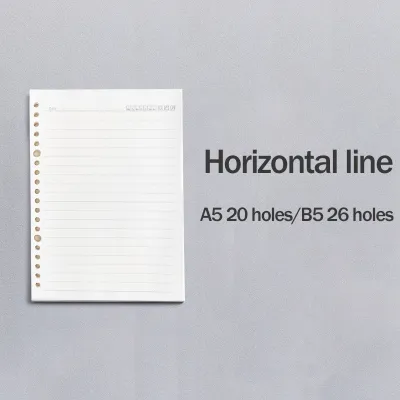
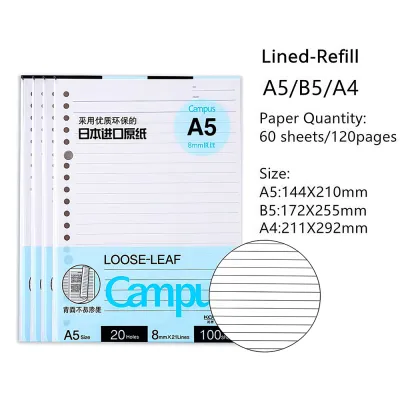
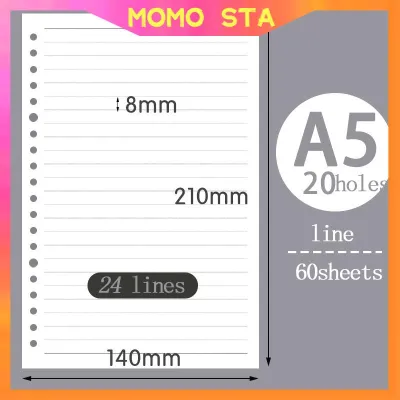
Ruled paper remains a reliable choice for linear text, essays, and meeting minutes where consistent baselines are essential. The horizontal lines provide a clear visual guide that keeps your handwriting straight and uniform across the page. This format is highly suitable for structured, text-heavy tasks where you need to write quickly without worrying about page layout or alignment. It minimizes cognitive load, allowing you to focus entirely on transcribing spoken words or drafting long-form paragraphs.
Products mentioned in this guide
Prices are valid at publication and may change. Please refer to the product page for the latest price.
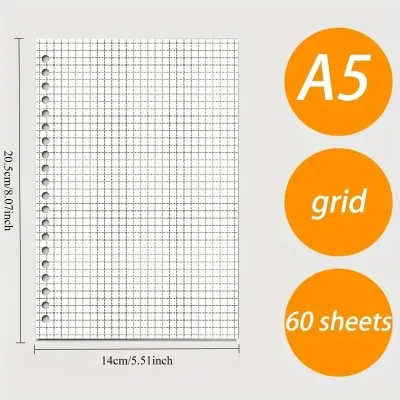
Grid paper is highly suited for mathematics, technical diagrams, and structured data tables that require precise horizontal and vertical alignment. The intersecting lines create a matrix of small squares, typically spaced five millimeters apart, which makes it easy to draw scale diagrams, plot graphs, or align columns of numbers. If you frequently work with equations, coding layouts, or structured planning, the rigid structure of grid paper ensures that every element remains proportioned and organized.
Dotted paper is favored for bullet journaling, flexible layouts, and habit trackers that require subtle guidance without visual clutter. The page is covered in a light grid of dots, usually spaced five millimeters apart, which disappear into the background once you fill the page with writing or drawings. This format offers a balance between the structure of grid paper and the freedom of blank paper. It allows you to easily draw straight lines, create custom boxes, and write in straight rows without the heavy, restrictive lines of traditional rulings.
Blank paper is ideal for freehand sketching, mind mapping, and unrestricted visual brainstorming. Without any pre-printed lines or dots to constrain your hand, you are free to draw diagrams, write at angles, and map out complex ideas organically. This format is highly appreciated by artists, designers, and visual thinkers who find that structured lines interrupt their creative flow. However, maintaining straight lines of text on blank paper requires more hand control, making it less suitable for rapid, long-form transcription.
Key Physical Specifications to Verify Before Purchasing
Before purchasing any binder notebook refill, you must verify its physical compatibility with your existing binder mechanism. Binder systems are not universally standardized, meaning that hole-punch patterns and paper sizes vary significantly between brands and regions. Common sizes include A4, B5, and A5, with hole configurations ranging from 6-hole and 9-hole systems to multi-ring 20-hole or 26-hole formats. Always count the rings on your binder and measure the spacing between them to ensure the refill pages will slide smoothly onto the rings without tearing.

Paper weight and thickness, measured in grams per square meter (GSM), are critical factors that determine how well the paper handles different inks. Standard loose-leaf refills often range from 70 GSM to 80 GSM, which is suitable for ballpoint pens and light pencil work but may suffer from show-through when using wet gel pens or highlighters. If you prefer using fountain pens, heavy gel inks, or creative markers, look for refills rated at 100 GSM or 120 GSM. Denser paper fibers resist ink penetration, reducing the likelihood of ghosting and bleeding on the reverse side of the page.
The surface texture of the paper, often described as its “tooth” or smoothness, directly influences your writing experience and ink drying times. Smooth, coated papers allow gel pens and fountain pens to glide effortlessly across the surface, preserving sharp line edges and vibrant ink colors. However, these smooth surfaces often require longer drying times, which can lead to smudging, especially in humid tropical environments. Conversely, toothy, uncoated papers absorb ink much faster, reducing smudging risks, but they may cause wet inks to feather or spread slightly.
Direct Comparison of the Four Refill Formats
To help you quickly evaluate which paper format aligns with your daily tasks, the table below contrasts the practical applications, limitations, and recommended writing tools for each type.
| Format | Primary Use Case | Potential Drawbacks | Recommended Pen Pairings |
|---|---|---|---|
| Ruled | Linear writing, lecture notes, journaling, and meeting minutes | Restricts vertical alignment and freehand sketching | Ballpoint pens, gel pens, and fine-liners |
| Grid | Mathematics, engineering diagrams, tables, and pixel planning | Heavy lines can make the page look cluttered or busy | Fine-point gel pens, mechanical pencils, and technical pens |
| Dotted | Bullet journaling, custom planners, and hybrid note-taking | Dots may be too faint for those needing strong linear guidance | Gel pens, brush pens, and medium-point felt tips |
| Blank | Sketching, mind mapping, calligraphy, and visual brainstorming | Hard to keep text straight without a guide sheet | Pencils, drawing pens, and calligraphy fountain pens |
It is important to note that performance traits such as ink drying speed, feathering, and bleed resistance are determined by the specific paper brand’s manufacturing process and fiber density, rather than the printed ruling pattern itself. A high-quality ruled refill can handle fountain pen ink beautifully, while a low-grade dotted refill may bleed even with a standard gel pen. Therefore, always prioritize paper specifications like GSM and coating alongside your preferred layout.
One of the greatest advantages of using a binder system is that you do not have to limit yourself to a single paper format. Many students and professionals find that a hybrid setup works best for their daily routines. For example, you can use ruled paper for writing-heavy lecture notes, grid paper for scientific calculations, and dotted paper for managing your weekly schedule, all organized within the same binder cover.
Decision Framework: Choosing Your Ideal Refill Paper
To finalize your selection, consider how your daily tasks, writing instruments, and binder capacity interact. Use the following conditional guidelines to choose the format that best supports your workflow:
- Choose Ruled if your primary focus is heavy text writing, formal note-taking, or transcribing lectures where speed and straight baselines are your main priorities.
- Choose Grid if you frequently draw charts, solve equations, design layouts, or prefer rigid structural boundaries to keep your work mathematically aligned.
- Choose Dotted if you want a highly versatile, hybrid approach that allows you to transition seamlessly between structured writing, custom planning, and creative sketching.
- Choose Blank if your work is entirely visual, unconstrained by lines, or if you use your binder primarily as a sketchbook or mind-mapping canvas.
Before making a purchase, always verify your binder’s ring capacity. Inserting high-GSM paper will reduce the total number of sheets your binder can comfortably hold. If you plan to carry multiple subjects in a single binder, opting for a slightly thinner but high-quality paper (such as 80 GSM with a smooth finish) may allow you to maximize page capacity without sacrificing too much ink resistance.
Frequently Asked Questions (FAQ)
Can I mix different paper formats in the same binder? (FAQ)
Yes, you can easily mix different paper formats in the same binder, provided that the paper size and hole-punch pattern match your binder’s ring mechanism perfectly. Combining formats is an excellent way to organize multi-subject binders. To maintain a clean and functional setup, use durable divider tabs to separate your sections by subject or paper type, allowing you to switch from ruled pages for writing to grid pages for drawing without cluttering your notes.
How do I prevent ink from bleeding through thin refill paper? (FAQ)
To prevent ink from bleeding through thin refill paper, first check the GSM rating of your current refills; if it is below 80 GSM, the paper is naturally more prone to show-through. If you cannot replace the paper, try switching to drier writing instruments, such as standard ballpoint pens or extra-fine gel pens, which deposit less ink onto the page. Additionally, placing a thick plastic sheet or a heavy piece of cardstock directly underneath the page you are writing on can act as a blotter, protecting the subsequent sheets from accidental ink transfer.

Community discussion
Share your experience or ask a question. Comments are reviewed before publication.