
Selecting the right financial calculator is one of the most critical decisions for a finance or accounting student in the Philippines. The choice between the Texas Instruments BA II Plus and CASIO’s financial lineup (such as the FC-200V or FC-100V) hinges on three primary factors: exam compliance, input logic, and long-term career goals. While Texas Instruments is the undisputed standard for global finance certifications, CASIO offers a familiar interface for students transitioning from high school scientific calculators. Understanding how these devices differ in daily use will help you avoid classroom setbacks and ensure your investment lasts throughout your academic and professional journey.
Exam and Curriculum Compliance
Before evaluating features or prices, you must verify which calculators are legally permitted in your target exams. For students aiming for global finance designations, the decision is often made for them. The CFA (Chartered Financial Analyst) Institute and the GARP (Global Association of Risk Professionals) for the FRM (Financial Risk Manager) exam strictly limit allowed calculators to a very short list. The Texas Instruments BA II Plus (including the Professional model) is one of the few universally accepted devices. If your career path includes these international credentials, practicing with the TI BA II Plus during your college years is highly advantageous, as it helps you build the necessary muscle memory and speed long before exam day.
For local examinations in the Philippines, the regulatory landscape is different. The Professional Regulation Commission (PRC) regulates the calculators permitted for the Certified Public Accountant (CPA) licensure exam and other local board assessments. The PRC periodically updates its list of allowed calculators to prevent academic dishonesty, often banning programmable models or those with text-storing capabilities. While CASIO financial models are widely used, you must cross-reference the specific model number with the latest official PRC resolutions before purchasing.
Products mentioned in this guide
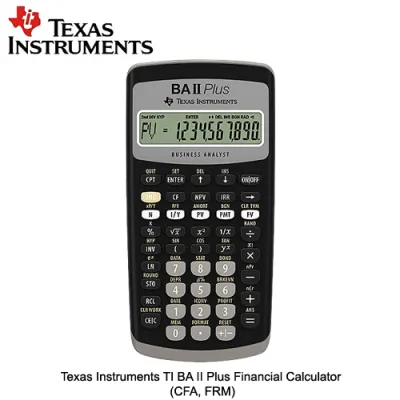
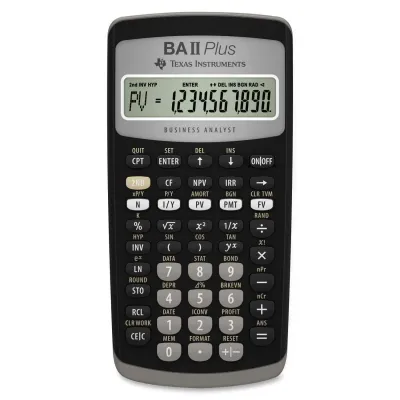

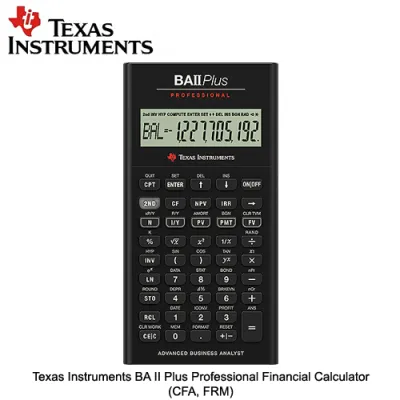
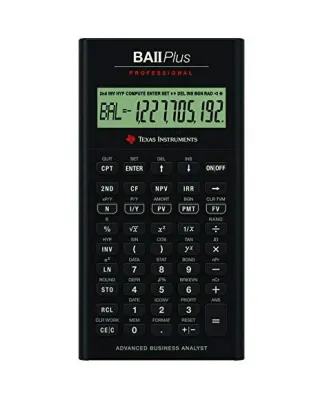

Prices are valid at publication and may change. Please refer to the product page for the latest price.
Furthermore, individual university departments and professors often dictate calculator policies. Some finance professors design their entire curriculum, lecture slides, and exam step-by-step guides around the TI BA II Plus, while others default to CASIO. Using a different brand than your instructor can make following complex classroom demonstrations difficult, as you will have to translate keystrokes on the fly. Always consult your course syllabus or ask your professor during the first week of classes before unboxing a new device.
Keystroke Logic and Learning Curve
The fundamental difference between these two brands lies in their mathematical entry systems. The TI BA II Plus operates on a traditional chain calculation logic. In a chain system, operations are performed in the exact order they are entered unless you explicitly use parentheses. For example, if you input 2 + 3 * 5 sequentially, a chain calculator will add 2 and 3 to get 5, then multiply by 5, resulting in 25. To get the mathematically correct order of operations (which yields 17), you must either use parentheses or change the calculator’s internal setting from standard chain (Chn) to Algebraic Operating System (AOS) mode. Learning to toggle and work within these settings is a necessary first step for any TI user.

In contrast, CASIO financial calculators typically utilize algebraic logic, often referred to as V.P.A.M. (Visually Perfect Algebraic Method) in their scientific lines. This system automatically respects the standard mathematical order of operations, executing multiplication and division before addition and subtraction. For most Filipino students, this algebraic logic feels immediately familiar because it mirrors the behavior of the CASIO scientific calculators used throughout high school.
This difference in logic extends to Time Value of Money (TVM) calculations. The TI BA II Plus features a dedicated row of physical keys for TVM variables: N (number of periods), I/Y (interest rate per year), PV (present value), PMT (payment), and FV (future value). To solve a problem, you simply enter a number and press the corresponding variable key. CASIO calculators, while also featuring dedicated keys, often rely on a menu-driven interface where you navigate to the TVM mode and input values into an on-screen list. Before committing to a purchase, it is highly recommended to test these basic TVM keystrokes in-store or simulate them using online manuals to see which workflow feels more natural to your learning style.
Key Features for Finance and Accounting Coursework
When evaluating these calculators for daily coursework, the physical layout and display capabilities play a massive role in your efficiency. The TI BA II Plus relies heavily on secondary functions (accessed via the 2nd key) to perform advanced calculations like Net Present Value (NPV), Internal Rate of Return (IRR), and depreciation. While this keeps the physical footprint compact, it requires memorizing multi-step key sequences. Once you master these sequences, however, the dedicated physical keys allow for incredibly rapid data entry without looking at the screen.
CASIO financial calculators shine when it comes to display readability. Many CASIO models feature multi-line dot-matrix displays that allow you to view several lines of data simultaneously. This is incredibly useful when entering long cash flow lists for NPV and IRR calculations or managing statistical data sets. On a single-line display like the standard TI BA II Plus, verifying your inputs requires scrolling through variables one by one, which increases the risk of missing a typo. CASIO’s multi-line screen lets you see the previous inputs at a glance, making troubleshooting much simpler during timed exams.
Physical durability is another critical factor, especially in the warm and humid tropical climate of the Philippines. High humidity can affect electronic components, battery contacts, and screen contrast over time. The TI BA II Plus is known for its robust, heavy-duty plastic casing and firm, clicky keys that offer clear tactile feedback. CASIO calculators are also highly durable but tend to feature softer, rubber-dome keys that are quieter but may feel less positive to some users. Additionally, consider the battery type: some models run on easily replaceable AAA batteries, while others use coin-cell batteries (such as the CR2032) that require a small screwdriver to replace. Keeping a spare battery in your pencil case is always a wise precaution before major exams.
Price, Availability, and Authenticity Checks
Financial calculators represent a significant financial commitment for college students, with prices generally ranging from ₱1,500 to over ₱3,500. CASIO calculators enjoy excellent local distribution in the Philippines. They are readily available in major national stationery chains, such as National Book Store, as well as local office supply shops. This widespread availability makes finding replacement units or accessories quick and convenient. The TI BA II Plus is more specialized and is typically found in larger flagship stationery branches or through official brand storefronts on major online marketplaces.
Because of the high demand and premium pricing of these academic tools, counterfeit calculators are a common issue in the local market. Purchasing a fake unit can lead to calculation errors, sudden battery failures, or outright bans from exam rooms. To protect your investment, perform several observable checks before finalizing your purchase. First, inspect the print quality on the keys and the calculator body; genuine units feature crisp, perfectly aligned, and durable lettering, whereas counterfeits often have blurry or slightly crooked printing. Second, examine the packaging for anomalies such as low-quality cardboard, faded colors, or spelling mistakes in the user manual.
Finally, verify the device’s internal software. Most genuine calculators have a built-in self-test mode. For example, on many CASIO models, pressing a specific combination of keys (such as Shift, 7, and On simultaneously) triggers a diagnostic screen that tests the LCD pixels and internal ROM. Genuine TI calculators also have specific diagnostic sequences. If a seller refuses to let you test the device or if the packaging looks suspicious, it is best to walk away and purchase from an authorized dealer.
Decision Framework: Which Calculator Should You Buy?
To make your final decision, use this structured framework based on your academic and career trajectory:
Choose the TI BA II Plus if:
- You are actively preparing for global finance credentials like the CFA or FRM exams.
- Your university curriculum or professor strictly mandates its use for classroom instruction.
- You prefer a dedicated, physical-key-driven workflow and do not mind a slightly steeper initial learning curve.
Choose a CASIO financial calculator if:
- You are primarily focusing on local Philippine university coursework and local board exams (always verify the current PRC permitted list first).
- You prefer a multi-line display that allows you to easily view and edit long lists of cash flows.
- You want a familiar algebraic entry system that matches the scientific calculator you used in high school.
Regardless of which brand you choose, always verify the permitted device list with your specific exam board or college department at the start of each academic year, as policies can change without prior notice.
Frequently Asked Questions (FAQ)
Can I use a standard scientific calculator for finance classes?
While a standard scientific calculator can handle basic arithmetic, exponents, and logarithmic functions, it lacks the dedicated pre-programmed formulas for financial mathematics. Solving complex problems like Net Present Value (NPV), Internal Rate of Return (IRR), amortization schedules, and bond valuation on a scientific calculator requires manual, multi-step algebraic formulas. This process is highly inefficient, time-consuming, and significantly increases the likelihood of calculation errors under the strict time limits of college exams.
Do I need to buy the Professional version of the TI BA II Plus?
The TI BA II Plus Professional edition includes a few advanced functions, such as Net Future Value (NFV), Modified Internal Rate of Return (MIRR), Modified Duration, and payback period calculations, along with a premium metal-like exterior and firmer keys. However, for the vast majority of undergraduate finance and accounting coursework in the Philippines, the standard TI BA II Plus is more than sufficient. The standard version offers excellent durability and covers all the essential TVM and cash flow functions required to pass your university exams and global certifications on a student-friendly budget.

Community discussion
Share your experience or ask a question. Comments are reviewed before publication.