
Selecting the right CASIO scientific calculator for your academic journey in the Philippines requires looking beyond the buttons on the faceplate. For senior high school (SHS) students in the Science, Technology, Engineering, and Mathematics (STEM) strand, as well as college engineering majors, this handheld device is an essential tool for daily problem-solving, classroom quizzes, and major examinations. Making the wrong choice can lead to academic setbacks, especially if you purchase a model that is banned in your classrooms or during professional licensure examinations.
The decision-making process involves aligning the calculator’s functional capabilities with your specific curriculum while strictly adhering to institutional guidelines. While standard models easily handle basic algebra and trigonometry, advanced engineering courses demand specialized features like matrix calculations, complex number operations, and numerical integration. By understanding these requirements early, you can invest in a single, reliable device that serves you from grade 11 all the way through graduation and your board exams.
Check Your School and Board Exam Requirements First
Before comparing specific models or features, your absolute first step must be verifying the calculator policy of your school, college department, and the relevant professional licensing board in the Philippines. Educational institutions and national testing authorities enforce strict rules regarding which devices are permitted in examination rooms. Purchasing a highly advanced calculator only to find out it is prohibited on exam day is a costly and stressful mistake that many students face.
Products mentioned in this guide

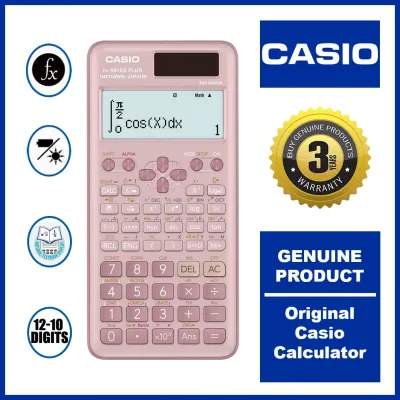
Prices are valid at publication and may change. Please refer to the product page for the latest price.
The primary distinction you must understand is between programmable and non-programmable scientific calculators. Programmable calculators allow users to store formulas, text, and custom scripts in the device’s internal memory. Because this capability presents a risk of academic dishonesty, almost all senior high schools, engineering colleges, and professional board exams strictly prohibit programmable models. Non-programmable calculators, which perform calculations in real-time without storing user-defined programs, are the standard requirement for academic and professional assessments.
For college engineering students, the stakes are even higher due to the regulations governing professional board exams. In the Philippines, licensing boards for civil, mechanical, electrical, chemical, and electronics engineering maintain specific lists of allowed calculator models. These lists are updated periodically to maintain exam integrity. A model that is permitted in your first-year college algebra class might not be allowed when you sit for your board exams years later.
To ensure your purchase is compliant, always consult your course syllabi, student handbook, or department chairperson before buying. If you are preparing for future licensure exams, check the official website of the local professional regulation commission for the most recent list of approved non-programmable calculators. When in doubt, ask upperclassmen or professors who have recently navigated the board exam process for their direct recommendations on compliant models.
Essential Features for Senior High School and Engineering Math
As you transition from basic high school mathematics to advanced engineering coursework, the complexity of your calculations increases exponentially. A basic scientific calculator that only handles fractions and square roots will quickly become a bottleneck. To keep pace with your lectures and exams, your chosen device must possess a specific suite of mathematical functions designed for engineering analysis.

Advanced calculations such as calculus, complex numbers, and matrix algebra form the backbone of engineering curricula. In subjects like electromagnetics, fluid mechanics, and structural analysis, you will regularly encounter systems of linear equations and multi-dimensional vectors. Your calculator should be capable of handling matrices up to a 4×4 dimension and performing vector dot and cross products. Additionally, the ability to perform numerical integration and differentiation directly on the device saves valuable time during timed exams.
Equation solvers and statistical regression tools are equally critical for physics and laboratory data analysis. Engineering experiments often require you to fit a curve to a set of observed data points to find trends. A calculator with robust statistical functions allows you to input data pairs and instantly calculate linear, logarithmic, or exponential regression coefficients. Built-in equation solvers, including polynomial and simultaneous equation solvers, allow you to find roots without tedious manual iterations.
Another feature that significantly improves usability is a Natural Textbook Display. This technology renders mathematical expressions, fractions, exponents, and radicals exactly as they appear in standard textbooks and on the whiteboard. Reading a complex fraction on a single-line display with multiple parentheses is highly prone to input errors. A natural display allows you to visually verify your input structure at a glance, reducing simple syntax mistakes that can ruin an entire multi-step engineering problem.
Compare Popular CASIO Scientific Calculator Lines
CASIO offers a diverse range of scientific calculators, categorized into distinct product lines that cater to different academic levels and budgets. Understanding the progression of these product lines helps you identify where your needs lie and prevents you from either under-buying or over-buying. The goal is to find a device that matches the mathematical rigor of your specific engineering discipline without violating local exam rules.
The transition from standard models to advanced series represents a leap in processing power, display resolution, and functional depth. While standard models focus on reliability and simplicity for general science subjects, the advanced series are engineered specifically to handle the heavy computational loads of college-level engineering. Selecting the right line ensures that your calculator remains a helpful tool rather than a source of frustration during complex exams.
Standard Scientific Calculators for General STEM Subjects
Standard scientific calculators are the traditional workhorses of high school classrooms. These models are designed to cover foundational mathematics, including algebra, geometry, trigonometry, and basic statistics. They are highly durable, often featuring hard slide-on cases that protect the screen and keys from the wear and tear of being tossed into a crowded school backpack.
For senior high school STEM students, a standard model provides all the necessary tools for pre-calculus, basic physics, and chemistry. These devices excel at calculating trigonometric functions, permutations, combinations, and logarithmic values. Because they have fewer menus and specialized modes, they are highly intuitive to use, allowing students to perform quick calculations without navigating complex sub-menus.
However, these standard models reveal their limitations once you enter a college engineering program. They generally lack the memory and processing capability to handle complex number matrices, high-order polynomial equations, or numerical calculus. Attempting to solve a system of three simultaneous equations manually using a standard calculator during a thermodynamics exam is incredibly time-consuming. If your long-term goal is an engineering degree, starting with a standard model may mean you will need to purchase an upgrade once you reach your second or third year of college.
Advanced ClassWiz Models for Complex Engineering Coursework
For students entering rigorous engineering programs, the advanced ClassWiz series represents the modern standard for non-programmable scientific calculators. These models feature high-resolution displays that can show formulas, tables, and menus with exceptional clarity. The increased screen real estate allows for an interactive, icon-based menu system that is much easier to navigate than the text-heavy menus of older models.
The primary advantage of these advanced models is their comprehensive feature set tailored for engineering. They can effortlessly solve up to 4×4 matrices, calculate vectors, and handle complex numbers in both rectangular and polar coordinates. Furthermore, they include advanced equation solvers, inequality solvers, and probability distribution calculations. Some models even feature spreadsheet functions and QR code generation, allowing you to visualize your data on a smartphone or tablet screen.
Beyond functional variety, advanced models offer faster processing speed and clear display quality. When calculating numerical integrations or solving complex systems of equations, older or lower-end processors can take several seconds to display a result. Advanced models execute these operations almost instantaneously. The high-contrast screen is also easier to read under the fluorescent lighting of college lecture halls or the natural light of outdoor study areas, reducing eye strain during long study sessions.
Your Pre-Purchase Verification Checklist
Because CASIO calculators are highly popular among students in the Philippines, the market unfortunately contains counterfeit and substandard imitation units. These fake calculators often look identical to genuine models at a glance but suffer from poor build quality, inaccurate calculation algorithms, and high failure rates during critical exams. Protecting your investment requires a careful pre-purchase verification process.
First, inspect the packaging and security seals of the calculator before purchasing. Genuine CASIO calculators sold in the Philippines typically feature specific holographic stickers, security seals, or QR codes on the box. You can scan these QR codes using a smartphone to verify the product’s authenticity on the official manufacturer website. Avoid buying calculators that are sold without retail packaging, or those with blurry printing and misspelled words on the box or the device itself.
Second, verify the warranty terms and the status of the retailer. Genuine units come with an official warranty card that is honored by authorized service centers in the Philippines. When shopping online, stick to official brand stores or highly rated, authorized stationery retailers on major ecommerce platforms. If you are purchasing from a physical bookstore or office supply shop, ask the sales representative for confirmation of their authorized dealer status and ensure they stamp or fill out your warranty card.
Third, compare prices in ₱ across multiple authorized retailers to identify suspicious deals. While it is natural to look for discounts, an extremely low price is often a primary indicator of a counterfeit product. If possible, visit a physical store to test the device in person. Press the keys to check for a tactile, responsive click, and adjust the screen contrast to ensure the display remains legible under humid conditions or different lighting environments. Investing a little extra time and money into a verified, genuine calculator ensures that your device will perform reliably throughout your entire academic career.
Frequently Asked Questions (FAQ)
Can I use a graphing calculator instead of a scientific one for engineering?
In most cases, you cannot use a graphing calculator for engineering courses or board exams in the Philippines. While graphing calculators offer powerful visualization tools and programmable features, their ability to store large amounts of data and custom programs makes them prohibited under standard exam guidelines. Most universities and the national professional licensing boards strictly ban graphing calculators to maintain a level playing field and prevent academic dishonesty. It is highly recommended to master the use of an approved, advanced non-programmable scientific calculator instead, as this is the tool you will be permitted to use during your most critical examinations.
What is the general difference between the fx-991 and fx-570 series?
The primary difference between the CASIO fx-991 and fx-570 series generally lies in their power sources rather than their internal mathematical functions. Models in the fx-991 series typically feature a dual-power system, utilizing both solar power and a backup battery, which provides peace of mind during long exams. The fx-570 series models usually rely solely on a single battery power source, making them slightly lighter but dependent on battery replacement over time. Because their functional capabilities and menu layouts are often identical within the same generation, you should choose based on your power preference, local retail availability in the Philippines, and specific model suffix approvals.

Community discussion
Share your experience or ask a question. Comments are reviewed before publication.