
Choosing the right sketching pencil set requires balancing your current control over the medium with the specific subjects you want to render. If you are just starting, a massive set with dozens of different grades can feel overwhelming and lead to muddy, smudged drawings. Conversely, an experienced artist will find a basic four-pencil set highly limiting when trying to capture deep, matte shadows or delicate atmospheric highlights. Understanding how graphite grades, core compositions, and casing quality interact allows you to choose a set that supports your creative growth without unnecessary expense.
In tropical environments like the Philippines, where relative humidity often exceeds 80 percent, selecting the right tools becomes even more critical. High humidity naturally softens paper fibers, making sheets more susceptible to tearing under hard pencil tips, while also causing soft graphite to smudge more easily. By matching your pencil set to your environment, skill level, and artistic goals, you can prevent common frustrations and enjoy a highly responsive drawing experience.
Quick Diagnostic Guide to Sketching Pencil Sets
To help you quickly identify your ideal starting point, use the diagnostic summary below to map your skill level and primary drawing goals to a recommended pencil set composition.
Products mentioned in this guide
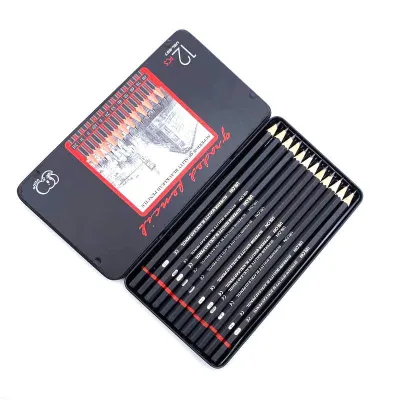
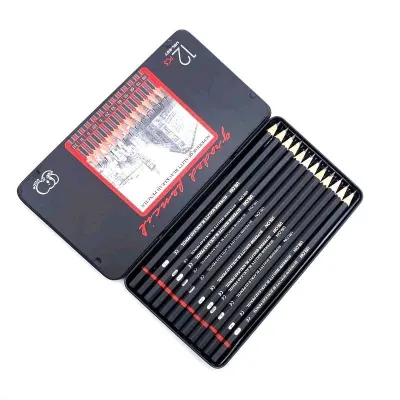
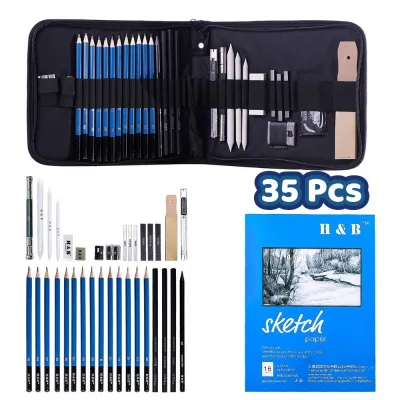
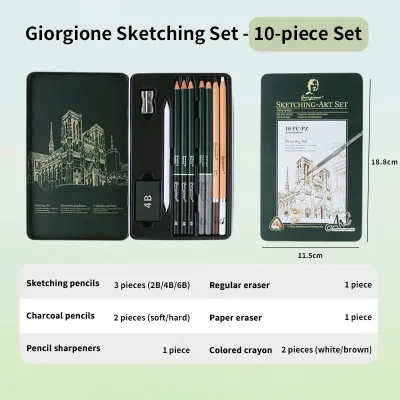
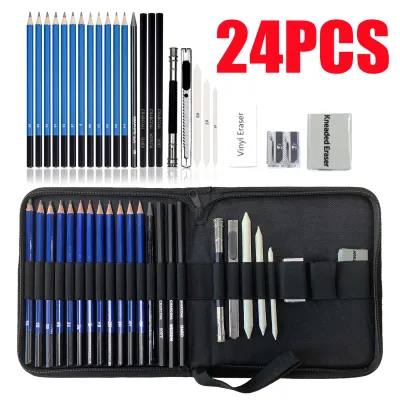
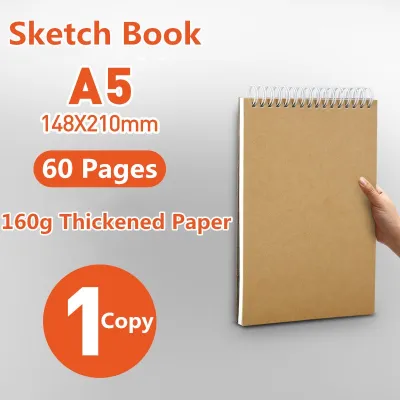
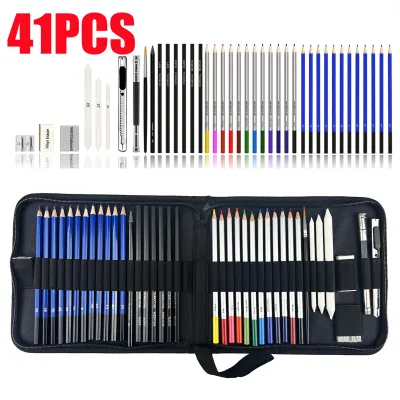
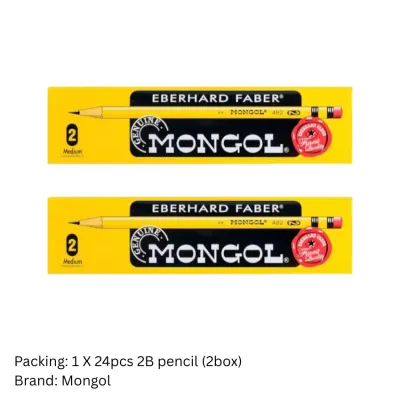
Prices are valid at publication and may change. Please refer to the product page for the latest price.
| Skill Level / Drawing Goal | Recommended Set Size | Ideal Grade Range | Primary Core Type | Best Use Case |
|---|---|---|---|---|
| Beginner / Foundational | 6 to 12 pencils | 2H to 4B | Pure Graphite | Mastering pressure control and basic shading |
| Intermediate / Tonal | 12 to 24 pencils | 4H to 8B | Pure Graphite | Smooth gradients, portraits, and varied textures |
| Advanced / Mixed Media | 12 to 24+ pencils | 9H to 9B, plus specialties | Graphite, Charcoal, & Carbon | High-contrast realism, deep matte shadows, and mixed media |
| Urban Sketcher / On-the-Go | 4 to 8 pencils | HB, 2B, 4B, 6B | Woodless or Soft Graphite | Gestural drawing, quick value blocking, and travel |
Step 1: Assess Your Current Sketching Skill Level
Before purchasing a new sketching pencil set, honestly assessing your current technical proficiency will save you from either outgrowing your tools too quickly or feeling overwhelmed by specialized mediums. Your skill level dictates how much control you have over pencil pressure, which directly influences how different graphite grades perform on paper.

Beginners: Focus on Control and Basics
For those who are new to sketching or returning to the craft, a compact set of 6 to 12 pencils is the most effective choice. Beginners should focus on a narrow, forgiving range of grades, typically spanning from 2H to 4B. At this stage, developing consistent pressure control is the primary objective.
Using extreme pencil grades can hinder your progress. For example, very hard pencils like 6H require significant downward pressure to leave a visible mark, which can easily dent or permanently emboss paper fibers—especially when local humidity has softened the sheets. On the other hand, extremely soft pencils like 8B release a large volume of loose graphite with minimal friction, leading to accidental smudging that can ruin a drawing before you learn how to manage your hand placement. A smaller, mid-range set encourages you to master a few highly versatile grades, teaching you how to achieve a wide spectrum of values simply by adjusting your hand pressure.
Intermediate Artists: Expanding Tonal Range
As you transition to intermediate work, your focus shifts toward rendering complex gradients, subtle mid-tone transitions, and realistic textures. At this stage, a medium-to-large set containing 12 to 24 pencils (typically spanning from 4H to 8B) becomes highly beneficial.
Intermediate artists understand how to control hand pressure but require incremental grades to avoid harsh, blocky transitions in their shading. Having access to adjacent grades, such as a 3B and a 4B, allows you to build smooth, seamless gradients without relying excessively on blending stumps. Blending stumps can grind graphite too deeply into the paper grain, flattening the texture and making further layering difficult. A wider set provides the exact hardness or softness needed to transition naturally from deep shadows to delicate highlights, allowing your technical rendering to become more polished and lifelike.
Advanced Sketchers: Specialized Precision and Texture
Advanced sketchers often demand extreme values and specialized textures that standard graphite sets cannot deliver. For this level of work, highly comprehensive sets or specialized mixed-media configurations are ideal. These sets frequently include niche grades like 9H for technical, near-invisible guidelines, or 9B and 10B for intense darks.
At this advanced stage, you are likely comfortable combining different core materials to achieve specific visual effects. Many professional-grade sets incorporate charcoal, carbon, or white pastel pencils alongside standard graphite. Advanced artists use these mixed sets to overcome the natural reflective sheen of heavy graphite under bright studio lights. Because advanced sketchers often curate their own custom palettes, buying a comprehensive, high-quality set serves as an excellent way to discover new textures and material behaviors before purchasing individual open-stock replacements.
Step 2: Match the Set to What You Want to Draw
Your choice of a sketching pencil set should also align with your preferred subject matter. Different genres of drawing rely on distinct tonal ranges, line qualities, and blending characteristics.
Portraits and Realism
Rendering human skin tones, soft hair, and lifelike eyes requires a pencil set with a strong emphasis on soft, dark B grades. A set rich in 2B, 4B, 6B, and 8B pencils is essential for building deep, rich shadows and smooth, realistic gradients without needing to press hard against the paper.
However, a realism set is not complete without a few harder H grades. While soft B pencils are perfect for blending the soft contours of a cheek or jawline, harder pencils like H or 2H are necessary for executing crisp, fine details. You will need these harder, sharp-tipped pencils to render individual hair strands, delicate eyelashes, and the sharp, clean reflections within an eye. Look for a set that offers a smooth, continuous transition from light H grades to very soft B grades to ensure your portraits have both depth and precise detail.
Landscapes and Architecture
Landscape and architectural drawing demand a highly balanced set with a robust selection of both hard H grades and soft B grades. Architectural sketching relies heavily on crisp, clean structural lines and precise cross-hatching, which are best achieved using H, F, and HB pencils. These harder grades hold a sharp point much longer under continuous use, preventing your lines from becoming thick and blurry.
In landscape drawing, harder pencils are also invaluable for creating atmospheric perspective, allowing you to draw distant mountains, clouds, and faint foliage with light, subtle values. Conversely, you will need the softer B grades to render foreground elements with rich texture and high contrast. Softer pencils are ideal for capturing the rough, organic texture of tree bark, the deep shadows under dense foliage, and the high-contrast crevices of stone walls.
Quick Gestural Sketches and Urban Sketching
If your passion lies in capturing quick gestural drawings, life studies, or urban scenes on the go, portability and speed are your top priorities. Instead of carrying a bulky 24-piece tin, a compact, travel-friendly set of 4 to 8 pencils is highly recommended.
For rapid sketching in dynamic environments—such as sketching commuters on a transit ride or capturing street scenes in Manila—you need pencils that offer quick value blocking and expressive line variation. Softer grades like 2B, 4B, and 6B are perfect for this style because their responsive cores allow you to transition from a thin line to a broad, dark stroke simply by tilting the pencil. Woodless graphite pencils are also excellent candidates for urban sketching, as they consist entirely of a thick graphite core protected by a thin lacquer coating, allowing you to lay down broad sweeps of tone very quickly.
Step 3: Decode the Pencil Set Composition
To make an informed purchase, you must look beyond the brand name and the total number of pencils in a set. Understanding the technical specifications of the cores and the construction materials will ensure you get a set that performs reliably.
Understanding the Graphite Grade Range
The standard European grading scale uses the letters H (Hard) and B (Black) to indicate the hardness and darkness of the pencil core. Harder pencils contain more clay binder, resulting in a lighter, thinner line, while softer pencils contain more graphite, producing a darker, thicker line. The scale runs from extremely hard (9H) to extremely soft (9B), with HB sitting directly in the middle. The F (Fine) grade sits between HB and H, offering a unique balance that sharpens to a durable, fine point ideal for writing and detailed drafting.
When evaluating a set, do not assume that a higher pencil count automatically means a better range. Some manufacturers pad their sets with duplicate HB or 2B pencils, or include extreme grades (like 9H) that you may never use. Always check the exact grade list printed on the back of the packaging. A high-quality, versatile 12-piece set should offer a logical, sequential progression (such as 2H, H, F, HB, B, 2B, 3B, 4B, 5B, 6B, 7B, 8B) rather than skipping crucial mid-tones.
Evaluating Core Types: Graphite, Charcoal, and Carbon
Not all sketching sets are made of pure graphite, and understanding the differences between core types is essential to avoid a material mismatch:
- Pure Graphite: This is the traditional sketching medium. It is highly versatile, easy to erase, and glides smoothly across the paper. However, heavy layers of soft graphite can create a highly reflective, shiny surface that can distort the appearance of dark values under direct light.
- Charcoal: Many mixed sketching sets include charcoal pencils. Charcoal provides an incredibly rich, deep, matte black finish with no reflective glare. However, it is highly volatile, smudges very easily, and is difficult to erase completely. It requires a textured paper to hold the pigment and a spray fixative to prevent smudging over time.
- Carbon: Carbon cores blend the best properties of graphite and charcoal. They offer a smooth, fluid drawing experience with a dark, matte finish that has significantly less reflective sheen than pure graphite, making them highly favored for portraiture and high-contrast illustrations.
For beginners, sticking to a pure graphite set is highly recommended to master fundamental value control without the added mess and complexity of charcoal.
Set Size vs. Quality: Evaluating Build and Materials
It is a common mistake to choose a massive, inexpensive set over a smaller, premium one. Low-cost, generic pencil sets often suffer from poor manufacturing standards, resulting in off-center cores, brittle graphite filled with scratchy impurities, and low-quality wood casings.
When a pencil core is off-center, one side of the wood casing is thinner than the other. When you sharpen the pencil, the thin side wears away too quickly, leaving the core unsupported and causing it to snap repeatedly under normal drawing pressure. Furthermore, cheap wood casings (such as those made from low-grade basswood or composite materials) are highly susceptible to warping in warm, humid climates. This warping puts physical tension on the internal graphite core, causing it to fracture into multiple pieces inside the pencil before you even sharpen it.
To verify quality before purchasing, look for sets from reputable stationery brands that use SV (secural) bonding, a manufacturing process where the core is glued to the wood casing along its entire length to prevent internal breakage. Premium sets typically use high-quality, straight-grained woods like California incense cedar, which sharpens smoothly without splintering and resists environmental humidity. Expect to pay around ₱150 to ₱400 for a reliable beginner set, while professional-grade 12-piece sets generally range from ₱600 to ₱1,500 or more.
When to Upgrade or Supplement Your Current Set
As your skills develop, you will eventually reach the physical limits of your starting pencil set. Recognizing these limits will help you expand your toolkit logically without spending money on unnecessary duplicates.
One of the most obvious signs that you need to upgrade is the inability to achieve deep, rich darks. If you find yourself pressing down hard with a 4B pencil to get a darker shadow, only to dent the paper or create a highly reflective, shiny grey patch, it is time to introduce softer grades like 6B, 8B, or even a matte carbon pencil. Frequent core breakage during sharpening is another clear indicator of low-quality materials, suggesting that your current set’s casings have warped or the cores have shattered internally.
Instead of immediately buying a completely new set, consider purchasing individual, open-stock pencils from a local art supply shop to fill specific gaps in your collection. This approach allows you to test different premium brands and specialized core types, such as carbon or charcoal, at a very low cost.
When introducing softer graphite, carbon, or charcoal pencils to your workflow, always verify your paper compatibility. The erasability, smoothness, and smudge resistance of any sketching pencil depend entirely on the specific combination of the pencil grade and the paper’s texture (known as “tooth”). To test this, perform a simple trial on a scrap piece of your drawing paper: sketch a small tonal scale from light to dark, then use a standard vinyl eraser to check how cleanly the pigment lifts. You will find that smooth paper (like standard copy paper) cannot hold heavy layers of soft graphite or charcoal, as it lacks the physical texture to scrape the pigment off the core. For softer, darker mediums, transition to a medium-tooth, acid-free sketching paper (typically 120 gsm to 200 gsm) to ensure proper adhesion and smooth blending.
Frequently Asked Questions (FAQ)
Are mechanical pencil sets better than wooden pencil sets for sketching?
Mechanical pencils are superior for technical drawings, fine architectural lines, and intricate details because their thin leads maintain a consistent width and never require sharpening. However, wooden pencils are far better for expressive, artistic sketching. The exposed wooden tip allows you to vary your line weight dynamically by changing the angle of the pencil, and you can use the flat side of the exposed core to shade broad areas quickly—techniques that are impossible with a standard mechanical pencil. Many artists use both tools together, using wooden pencils for the main shading and mechanical pencils for final, sharp details.
How do I know if a sketching pencil set has good quality before buying?
You can evaluate a set’s quality by inspecting the unsharpened ends of the pencils. The graphite core should be perfectly centered within the circular or hexagonal wood casing. The wood should have a smooth, satin finish with no visible cracks, splinters, or rough edges. Additionally, check the packaging for clear, consistent grading labels (such as 2B, 4B) and look for reputable art brands that explicitly mention break-resistant bonding (such as SV bonding) on their packaging, which guarantees a much longer lifespan and fewer sharpening frustrations.

Community discussion
Share your experience or ask a question. Comments are reviewed before publication.