
Selecting the right Worx specialty paper for your daily tasks requires a careful look at how ruling formats, paper weights, and binding styles interact with your writing tools and organizational habits. In the tropical climate of the Philippines, where high humidity can soften paper fibers and slow down ink drying times, choosing the correct paper specification becomes even more critical. Rather than relying on general assumptions about paper performance, verifying the exact details on the product label ensures your pens glide smoothly without bleeding through the page. By matching your specific writing instruments and organizational workflows to the right paper characteristics, you can avoid common frustrations like feathering, warping, or binder misalignment.
Understanding the technical specifications of your stationery prevents costly purchasing mistakes. Different projects demand different paper behaviors; a sketch artist requires a completely different texture and weight than a student taking rapid lecture notes or an accountant organizing financial ledgers. By taking a systematic approach to evaluating paper formats, weights, and binding types, you can build a highly efficient setup tailored to your exact creative or professional needs.
Comparing Worx Paper Formats and Ruling Styles
Paper layouts dictate how you organize your thoughts, drawings, and data. The Worx specialty range offers several ruling styles designed for distinct tasks, and choosing the right one depends heavily on your handwriting size and structural planning habits. Standard ruled or lined sheets are the most common, providing horizontal guides that keep your text straight and orderly. If you have large, expressive handwriting, wider line spacing prevents your letters from overlapping, while those with smaller, precise print often prefer narrower ruling to maximize page utility.
Products mentioned in this guide
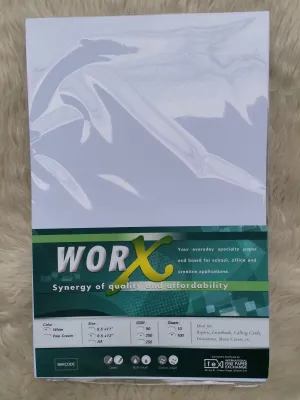
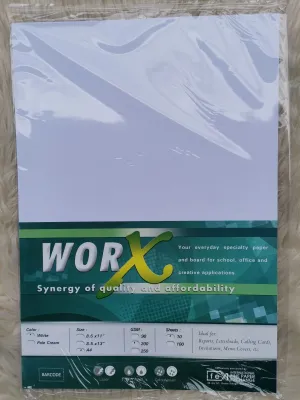
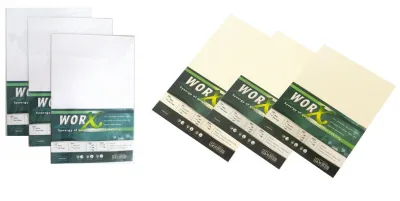
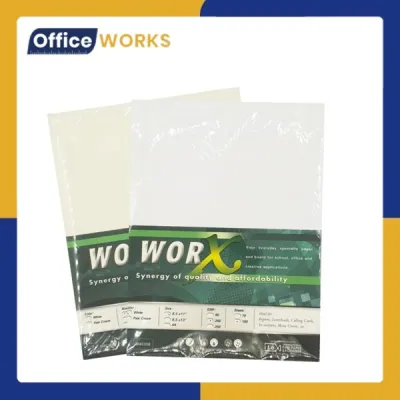
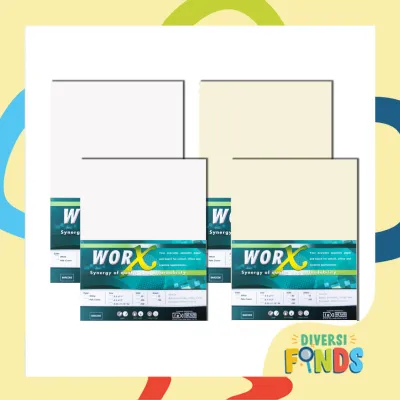
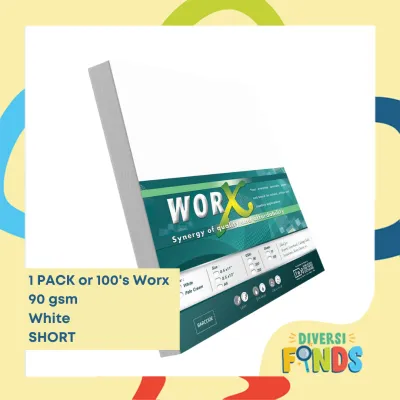
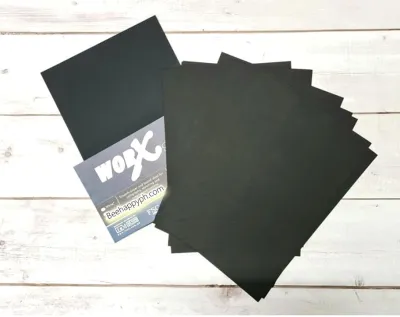
Prices are valid at publication and may change. Please refer to the product page for the latest price.
Grid or graph formats offer both horizontal and vertical guidelines, typically spaced at five-millimeter intervals. This structure is highly beneficial for technical drawings, mathematical equations, architectural sketches, and precise data tracking. The visible grid lines allow you to align columns and create charts without needing a ruler, making it a favorite for engineering students and bullet journal enthusiasts who value geometric precision.
Dotted paper serves as a subtle compromise between grid and blank formats. The faint dots provide just enough guidance to keep your writing straight and your diagrams aligned, yet they virtually disappear when you step back to look at the page as a whole. This format is highly versatile for creative layouts, allowing you to transition seamlessly from writing paragraphs to sketching freehand diagrams without the visual clutter of solid lines.
Blank or plain specialty paper offers absolute freedom from structural constraints. Without lines or dots to guide your hand, you can sketch, mind-map, or practice calligraphy in any direction or angle. However, writing in straight lines on blank paper requires a steady hand and consistent practice, making it more suitable for artistic endeavors, brainstorming sessions, or formal certificates rather than rapid, everyday note-taking.
Before purchasing, always check the margins and header spaces on the paper. Some formats include dedicated blocks for dates, page numbers, or subject titles at the top, while others feature clean, borderless edges. If your workflow requires clean margins for annotations or binding clearances, verifying these layout details on the packaging or product description will prevent your writing from feeling cramped or getting cut off.
Evaluating Paper Weight, Texture, and Ink Compatibility
Paper weight is measured in grams per square meter (GSM), which directly indicates the thickness, density, and opacity of the sheet. Standard everyday copy paper typically ranges from 70 GSM to 80 GSM, which is highly suitable for ballpoint pens, pencils, and standard printing tasks. However, if you prefer using wet inks, such as those from fountain pens, gel pens, or liquid ink rollerballs, lighter paper weights may suffer from ghosting—where the writing is visible on the reverse side—or actual bleed-through, where the ink saturates completely through the sheet.

For heavy ink applications, calligraphy, or double-sided writing, opting for heavier specialty paper ranging from 100 GSM to 200 GSM or more is highly recommended. Thicker paper fibers absorb more liquid without warping, ensuring that your pages remain flat and professional. Heavy-weight paper also provides a more substantial, premium feel, making it ideal for official documents, certificates, and presentation materials that need to withstand frequent handling.
Surface texture is another critical factor that influences how your writing instrument behaves on the page. Worx specialty papers come in various finishes, including ultra-smooth, matte, and textured or linen surfaces. Smooth finishes minimize friction, allowing fine-liner gel pens and fountain pen nibs to glide effortlessly across the page without skipping. This smoothness helps maintain sharp, crisp lines and prevents the pen tip from catching on the paper fibers.
Textured or linen finishes, on the other hand, provide a tactile resistance that many pencil and ballpoint pen users find satisfying. The slight tooth of the paper grabs the graphite or ink, offering greater control over your strokes. However, highly textured surfaces can cause wet inks to feather—where the ink spreads sideways along the paper fibers—resulting in fuzzy, less defined lines. If you plan to use fountain pens or brush pens, verifying that the paper has a smooth, well-sized finish is essential for maintaining clean line edges.
In humid tropical environments, ink drying times can increase significantly. Highly calendered, ultra-smooth papers often slow down drying times even further because the ink sits on top of the surface rather than absorbing instantly. If you are left-handed or write quickly, check the manufacturer’s specifications for ink compatibility, or perform a quick trial on a single sheet to determine how long your preferred ink takes to dry completely before you turn the page.
Notebooks vs. Loose-Leaf: Selecting the Right Binding and Refill
Deciding between a bound notebook and a loose-leaf paper system depends on how you prefer to carry, organize, and archive your work. Bound formats, such as spiral-bound, stitched, or glued notebooks, offer excellent structural integrity and portability. They keep all your pages securely in one place, preventing loose sheets from getting lost or damaged in your bag. Bound notebooks are highly durable for daily travel and provide a permanent, chronological record of your thoughts, making them ideal for personal journals, laboratory logs, or single-subject lecture notes.
Loose-leaf paper systems offer unmatched flexibility for dynamic workflows. With loose-leaf sheets, you can easily insert, remove, rearrange, or discard pages as your projects evolve. This modularity is incredibly useful for multi-subject binders, professional portfolios, or customizable planners where you need to update information regularly. It also allows you to carry only the pages you currently need, significantly reducing the weight of your daily bag.
When choosing loose-leaf paper, verifying binder compatibility is crucial. Do not assume that all loose-leaf sheets fit every binder system. You must check the exact hole-punch pattern, including the number of holes (such as 2-hole, 3-hole, 4-hole, or multi-ring configurations like 20-ring for A5 and 26-ring for B5) and the precise spacing between them. Measuring the distance from center to center of your binder rings and comparing it to the product specifications will prevent alignment issues.
Margin clearance is another essential check for loose-leaf systems. Ensure there is sufficient space between the punched holes and the active writing area so that the binder rings do not obstruct your hand while writing. Additionally, look for reinforced holes or high-GSM paper if you expect to turn the pages frequently, as thin paper can easily tear away from the rings under active, daily use.
Paper edge finishing also plays a role in long-term durability. Some bound notebooks feature micro-perforated pages, allowing you to tear out sheets cleanly when needed. If you choose a perforated notebook, inspect the quality of the perforation to ensure it is deep enough to tear easily without ripping the main body of the page, yet sturdy enough to keep the pages intact during normal handling.
Decision Framework: Matching Paper to Your Daily Tasks
To finalize your choice, it helps to match specific paper characteristics directly to your primary daily tasks. If your routine consists of structured note-taking, financial record-keeping, or systematic planning, structured formats like ruled or grid paper are highly suitable. For instance, a student preparing for mathematics or science courses will find grid paper invaluable for keeping numbers aligned and drawing diagrams, while a creative writer will naturally gravitate toward the clean, horizontal guidance of ruled sheets.
If your daily tasks involve freehand sketching, mind mapping, or artistic lettering, unstructured formats like blank or dotted specialty paper are much more appropriate. Calligraphers and designers benefit from the lack of solid lines, which allows them to focus entirely on the form and flow of their designs. Dotted paper remains an excellent middle ground for those who want the freedom to sketch but still require a subtle guide for occasional text blocks.
Before making a purchase, always run through a few “Verify first if…” scenarios to ensure complete compatibility with your tools and preservation needs:
- Verify first if you use heavy wet inks or markers: Ensure the paper weight is at least 100 GSM to prevent bleed-through and warping, and check for a smooth finish to avoid ink feathering.
- Verify first if you require long-term document preservation: Check the product label for acid-free or archival-quality indicators to ensure the paper will not yellow, become brittle, or degrade over time under tropical storage conditions.
- Verify first if you are matching paper to a specific planner or binder: Measure the exact millimeter dimensions of the paper and the ring spacing of your binder, rather than relying on generic size names which can vary between manufacturers.
What to Check on the Label Before Purchasing
When browsing online marketplaces or retail shelves, reading the product label carefully is the best way to ensure you get the exact paper variant you need. The most critical detail to verify is the exact dimensions of the paper. In the Philippines, standard paper sizes can sometimes be confusing; “short” typically refers to US Letter size (8.5 x 11 inches), while “long” often refers to the local folio size (8.5 x 13 inches) rather than US Legal size (8.5 x 14 inches). Always check the precise measurements in millimeters or inches printed on the packaging to ensure a perfect fit for your printer, binder, or clipboard.
Next, verify the sheet count and the precise GSM rating. Specialty papers are often sold in smaller packs, such as 10-sheet or 20-sheet packs for heavy cardstocks, or larger 50-sheet to 100-sheet packs for standard writing refills. Double-checking these numbers ensures you are getting the correct volume for your project budget and that the paper thickness matches your intended writing instrument.
Look closely for environmental and archival certifications on the label. Indicators such as “acid-free,” “pH-neutral,” or “elemental chlorine-free” are vital if you are printing certificates, archiving legal documents, or creating artwork that needs to last for decades. These treatments prevent the paper from reacting with atmospheric moisture and light, preserving both the paper structure and the ink clarity.
Finally, always cross-reference the exact product code or SKU listed on the packaging. Manufacturers often produce very similar-looking packaging for different paper finishes, such as mistaking a textured linen specialty paper for a smooth board variant. Verifying the SKU against your digital shopping cart or retail list ensures you receive the exact texture, weight, and format required for your stationery setup.
Frequently Asked Questions (FAQ)
Can I use fountain pens on all Worx specialty paper finishes?
Fountain pen compatibility depends heavily on the paper’s GSM, surface texture, and sizing. While smooth, high-GSM Worx specialty papers generally handle fountain pen inks well, highly textured or lower-GSM variants may cause feathering or bleed-through. To ensure a clean writing experience, verify the paper’s specifications for ink compatibility or perform a small trial stroke on an inconspicuous area before writing extensively.
How do I know if Worx loose-leaf paper will fit my existing binder?
To guarantee a perfect fit, measure the distance between the rings of your binder from center to center and compare these measurements with the hole-punch spacing listed on the paper packaging. Additionally, check the overall paper dimensions (such as A5 or B5) and ensure the margin clearance is wide enough so the binder rings do not overlap your written notes.

Community discussion
Share your experience or ask a question. Comments are reviewed before publication.