
Choosing the right professional watercolor depends entirely on how the paint interacts with your specific techniques, paper, and workflow. While White Night watercolors offer a distinct formulation, comparing them against other professional brands requires looking past marketing and focusing on verifiable pigment properties, lightfastness ratings, and physical handling. This guide breaks down the objective dimensions you need to evaluate, helping you match the paint’s actual characteristics to your artistic style rather than relying on generalized brand reputations.
In tropical environments like the Philippines, where high relative humidity and warm temperatures directly affect how paint dries on the palette and behaves on paper, understanding these physical properties is even more critical. A paint that remains moist and easy to rewet can be a major advantage outdoors, but it may require different handling in a humid indoor studio. By analyzing the binder composition, pigment load, and format options, you can make an informed decision that enhances your creative process.
Understanding White Night Watercolor Characteristics
When exploring professional watercolors, the first step is verifying the exact product line on the packaging. The brand, widely known as “White Nights” and manufactured by Nevskaya Palitra, is a classic extra-fine artists’ watercolor line. Checking the manufacturer’s official labels ensures you are purchasing their professional-grade range rather than their student-grade alternatives, as the packaging designs can sometimes look similar to the untrained eye.
Products mentioned in this guide
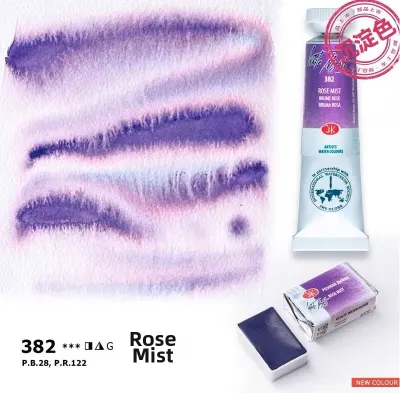
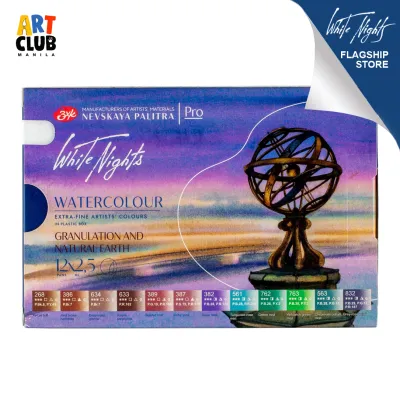
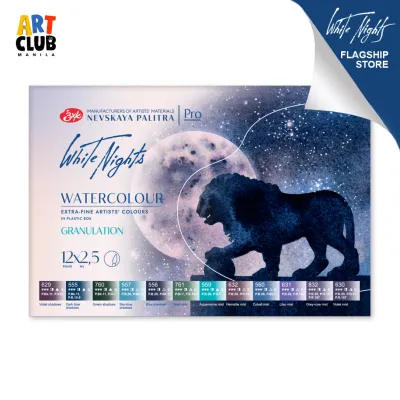
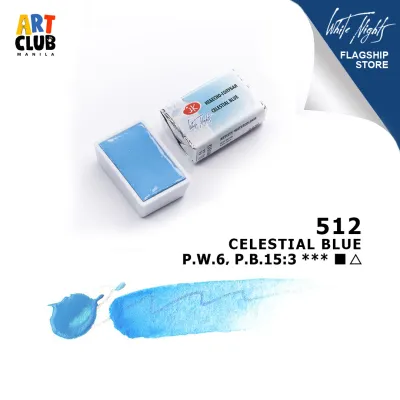
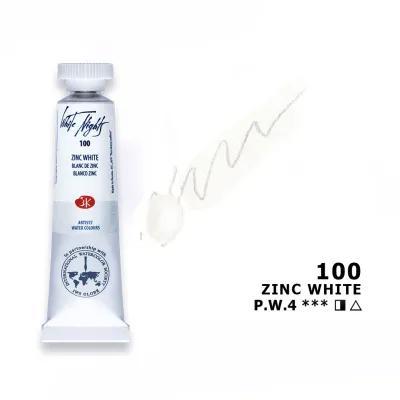
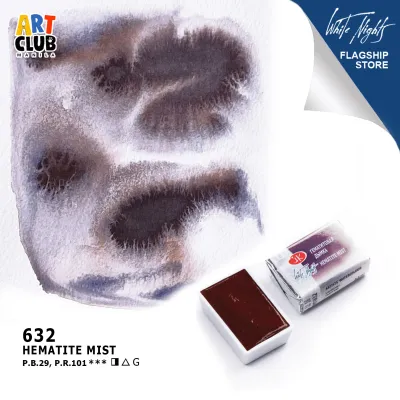
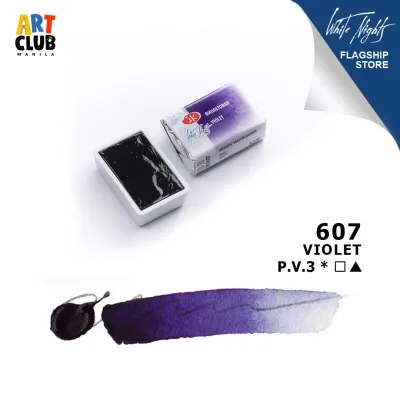
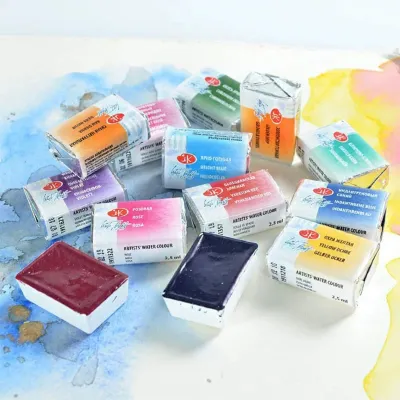
Prices are valid at publication and may change. Please refer to the product page for the latest price.
These watercolors are highly regarded for their traditional formulation, which utilizes a gum arabic binder combined with honey as a natural plasticizer and humectant. The inclusion of honey keeps the paint naturally semi-moist in the pan, allowing for exceptionally fast rewetting with minimal water. This characteristic is particularly noticeable in humid climates, where the paint remains soft and highly receptive to a wet brush, though it also means the pans can become slightly sticky if stored in warm, sealed spaces.
The brand is primarily famous for its full pans, which contain approximately 2.5 milliliters of paint—nearly double the volume of standard half-pans commonly offered by Western professional brands. They are also available in tubes, giving artists the flexibility to squeeze fresh, highly concentrated paint directly onto a mixing tray or to refill empty pans. Observing the packaging will reveal whether a specific color is a single-pigment or a multi-pigment blend, which directly influences how clean your color mixes will remain.
To understand how a specific shade will behave on your paper, you must consult the manufacturer’s official color chart or the symbols printed on the individual wrappers. These labels indicate the lightfastness (often represented by stars, where three stars denote high lightfastness), transparency (indicated by an empty square for transparent, a diagonal line for semi-transparent, and a filled square for opaque), and granulation tendencies. Because these properties are inherent to the specific pigments used, they serve as your primary guide before you even touch brush to paper.
Key Comparison Dimensions for Professional Watercolors
Evaluating professional watercolors requires a systematic approach based on objective, observable criteria rather than brand prestige. The first dimension to analyze is the pigment load and lightfastness. Professional-grade paints should clearly list the pigment index codes (such as PB29 for Ultramarine Blue or PY43 for Yellow Ochre) and their lightfastness rating according to international standards like the ASTM (American Society for Testing and Materials) or the Blue Wool Scale. Checking these ratings on the tube ensures your artwork will resist fading over time when exposed to ambient light.

Rewetting and flow characteristics represent the second critical dimension. To evaluate this, you can perform a simple rewetting test: allow a dab of tube paint to dry completely in a pan, then observe how many brush strokes are required to lift a saturated wash of color. Some professional brands dry to a hard, glass-like finish that requires pre-spraying with water, while honey-bound formulas like White Night rewet almost instantly. Additionally, testing the flow of the paint involves dropping a concentrated bead of color into a wet wash on both cold-pressed (textured) and hot-pressed (smooth) paper to observe how far and how evenly the pigment disperses.
The third dimension is the color shift and mixing capability of the paint. Watercolors naturally undergo a drying shift, often appearing lighter and less saturated once dry than when wet. You can measure this shift by painting a solid gradient swatch, letting it dry completely under your local room conditions, and comparing the dry end to a freshly painted wet patch. Furthermore, testing for mud-resistance involves mixing complementary colors (such as blue and orange) to see if they produce clean, neutral grays or if they break down into dull, chalky mixtures, which is highly dependent on the purity of the pigments and the presence of fillers.
Matching Watercolor Properties to Painting Techniques
No single watercolor brand is universally perfect for every artistic style because different painting techniques demand distinct physical properties from the medium. The ratio of binder to pigment, the natural granulation of specific minerals, and the speed at which the paint rewets or dries all dictate how well a paint performs under specific studio conditions. By matching these physical traits to your preferred workflow, you can select a paint system that works with your style rather than against it.
Wet-on-Wet and Expressive Styles
For artists who favor loose, expressive techniques and extensive wet-on-wet washes, the paint’s dispersion rate is paramount. You should look for watercolors that exhibit a high flow rate, allowing pigments to travel dynamically across wet paper to create soft, organic gradients. In a tropical climate, the natural humidity already extends the drying time of your paper, giving you a wider window to manipulate these fluid washes.
Granulating pigments also behave beautifully in large, watery washes, settling into the valleys of cold-pressed or rough paper to create rich, textured effects. When evaluating paints for this style, verify how predictably the granulating colors separate from the binder when heavily diluted. A paint with a highly active flow will disperse effortlessly, while a more controlled, viscous formula might require active brushwork to spread across a large wash.
Detailed Illustration and Botanical Art
Detailed illustration, botanical art, and precise glazing techniques require an entirely different set of paint characteristics. For these styles, you must prioritize paints with minimal color shift and exceptional transparency. Clean, multi-layered glazing relies on applying thin, transparent washes over dry layers without lifting or muddying the paint underneath, which requires a binder that cures reliably and pigments that are finely ground.
Finely ground pigments are crucial because they prevent clogging in detail brushes and ensure smooth, flat washes without unwanted granulation. When selecting colors for detailed work, check the manufacturer’s opacity ratings to avoid semi-opaque or opaque pigments that might obscure your underlying pencil lines or previous paint layers. A highly controlled, low-flow watercolor is often preferred here, as it stays exactly where the brush places it.
Urban Sketching and Plein Air
Urban sketching and plein air painting introduce practical, environmental challenges that demand portable and highly responsive materials. When painting outdoors, especially in warm or windy conditions, water evaporates rapidly from your palette and paper. Therefore, the rewetting speed of your dry pans is the most critical factor; you need a paint that yields rich, saturated color immediately upon contact with a damp water brush.
The physical format of your palette also plays a major role in outdoor efficiency. Full pans offer a larger surface area for quick color pickup with medium-sized travel brushes, whereas half-pans allow you to pack a wider variety of colors into a compact, pocket-sized tin. Evaluating the durability of the travel casing and ensuring the pans do not slide or melt under direct sunlight will keep your mobile setup clean and functional.
Evaluating Cost, Availability, and Format Options
Pragmatic purchasing decisions require balancing your artistic needs with local market realities, particularly regarding cost, format, and availability in the Philippines. When evaluating the financial aspect, calculate the cost-per-milliliter of tube paints (typically sold in 10ml or 21ml sizes) against the cost of pre-filled full or half-pan sets. While a pre-packaged set of White Night full pans often presents a highly competitive entry price in local currency (₱), purchasing individual tubes of specialized colors can be more cost-effective in the long run if you only use a specific core palette.
Buying a comprehensive set is an excellent way to quickly acquire a balanced spectrum of colors, but it often includes pigments you may rarely use, such as black or certain semi-opaque earth tones. Conversely, building a customized palette by purchasing individual tubes allows you to select only single-pigment colors that align with your specific mixing style. You can then squeeze these tubes into empty pans, allowing them to dry under your local studio conditions to create a personalized, highly efficient travel set.
Because watercolors are imported, verifying the condition of the stock before purchasing from online art supply stores or local ecommerce platforms is essential. High humidity and improper storage can affect the binder, sometimes causing the honey-based binder to separate from the pigment in the tube or leading to mold growth in poorly ventilated warehouses. When ordering, check customer reviews for mentions of separated or dried-out paint, verify that the seller is an authorized distributor to avoid counterfeit products, and inspect the tubes upon arrival to ensure the seals are intact and the paint is smooth and uniform.
Decision Framework: When to Choose White Night or Alternatives
To finalize your choice, use this conditional framework to match your current artistic level, technique, and budget to the right watercolor system:
- Choose White Night if: Your personal swatch tests confirm that their characteristic high flow, rapid rewetting speed, and rich, honey-bound consistency align with your painting style. This brand is highly suitable if you prefer working with full pans, enjoy expressive wet-on-wet techniques, and want professional-grade pigment quality at a highly accessible price point in the local market (₱).
- Choose Alternatives if: Your specific workflow demands highly specialized properties, such as extremely low-flow pigments for ultra-precise botanical details, unique multi-tonal granulating colors, or a completely vegan formulation (as honey-bound paints are not vegan). You should also look to alternative professional brands if you require a wider selection of modern, high-performance single-pigment synthetic colors that do not shift significantly upon drying.
- Verify First if: You are transitioning from student-grade paints to professional-grade watercolors for the first time. Before investing in a complete, expensive set of any brand, purchase a manufacturer's dot card or a small three-tube primary mixing set. Painting a simple color wheel and a few test gradients on your preferred watercolor paper will allow you to observe how the paint handles under your local humidity and temperature before making a larger financial commitment.

Community discussion
Share your experience or ask a question. Comments are reviewed before publication.